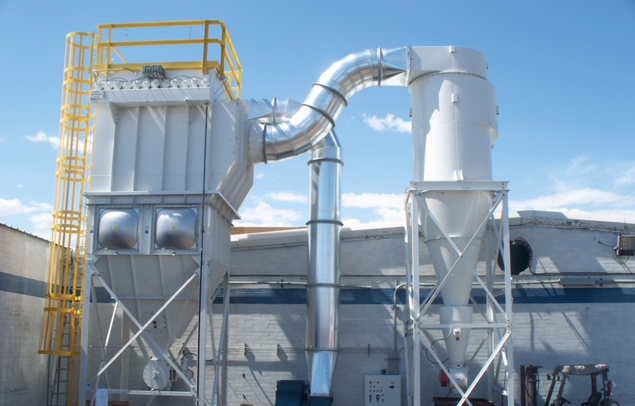
Dust is a common byproduct of many industrial activities, including cutting, grinding, sanding, mixing, conveying, crushing, and packaging. When fine particles become airborne, they can settle on machinery, products, floors, and work surfaces. Depending on the material and level of exposure, airborne dust may also create respiratory concerns, reduce visibility, affect product quality, or contribute to fire and explosion hazards. Effective dust management is therefore an important part of industrial facility planning.
A Dust Collector is a system designed to capture dust-laden air, separate particulate matter, and return or discharge cleaned air according to the installation design and applicable requirements. Common systems use filter bags, cartridges, cyclonic separators, or combinations of collection technologies. The correct arrangement depends on particle characteristics, airflow demand, operating conditions, and the risks associated with the dust being generated.
1. Captures Dust Near Its Source
One of the most effective ways to manage industrial dust is to capture it as close as practical to the point where it is produced.
Extraction hoods, enclosures, and capture arms can be positioned around cutting tools, transfer points, mixers, or other dust-generating equipment. Capturing particles before they disperse through the workspace can reduce the amount that reaches surrounding areas.
The hood design and its position are important. If it is too far from the emission point or does not provide adequate airflow, dust may escape into the work environment.
2. Uses Airflow to Transport Particles
After capture, dust-laden air travels through ductwork toward the collector. The system must provide sufficient airflow to move particles through the ducts without allowing excessive settling or creating unnecessary energy demand.
Duct diameter, length, bends, branch connections, and air velocity all affect performance. Poorly planned ductwork can lead to uneven extraction, blockages, or excessive pressure losses.
A system designer should calculate airflow requirements for the connected capture points and consider whether several machines will operate at the same time.
3. Separates Dust from the Air
Dust collectors use different separation methods depending on the application.
- Cartridge collectors: Use pleated filter elements to provide substantial filtration area within a compact arrangement.
- Baghouse collectors: Use fabric filter bags and are commonly applied in larger industrial dust-handling systems.
- Cyclone separators: Use centrifugal action to remove suitable larger particles from an air stream, often as a pre-separation stage.
- Wet collectors: Use liquid to capture particles in applications where the process and material are compatible with this method.
The most appropriate technology depends on particle size, dust concentration, temperature, moisture, chemical properties, and required filtration performance.
4. Helps Protect Equipment and Product Quality
Dust accumulation can affect machinery by entering bearings, electrical enclosures, ventilation openings, and moving mechanisms. It may also contaminate products or interfere with sensitive production processes.
A properly designed collection system helps limit airborne contamination around equipment and work areas. This can reduce cleaning demands and support more consistent production conditions.
However, dust collection should be considered alongside equipment enclosures, housekeeping, ventilation, and other process controls. It is not a substitute for all workplace exposure controls.
5. Supports a More Organized Workplace
When dust settles on floors, platforms, and machinery, cleaning can become a repeated operational task. Collected dust can instead be directed toward designated hoppers or disposal containers, depending on the system design.
This helps make dust handling more organized and can reduce the spread of particles during routine production. Collection bins should be emptied using procedures appropriate for the material, avoiding practices that reintroduce dust into the air.
Housekeeping remains essential, particularly in areas where dust can accumulate in hidden or elevated locations.
6. Considers the Risks of Combustible Dust
Some industrial dusts can ignite or explode when dispersed in air under suitable conditions and exposed to an ignition source. Materials such as certain organic powders, metals, and other fine solids may require special evaluation.
Facilities should identify the properties of the materials they handle and arrange a qualified combustible-dust hazard assessment where relevant. Collector location, venting, isolation, suppression, bonding, grounding, and other protective measures should be selected based on the assessment and applicable regulations.
A standard filter unit should never be assumed to provide explosion protection simply because it collects dust.
7. Maintains Filtration Performance
Filters gradually accumulate dust, increasing resistance to airflow. Many industrial collectors use pulse-jet cleaning or other mechanisms to remove accumulated material from filter surfaces.
Operators should monitor pressure differential, airflow, filter condition, and dust discharge. A sudden change in pressure or extraction performance may indicate damaged filters, blocked ducts, poor cleaning, or another system fault.
Maintenance schedules should include inspection of filters, seals, fans, valves, hoppers, and controls.
8. Selects a System for the Actual Application
Before purchasing equipment, identify the dust source, material properties, required capture points, airflow demand, operating hours, and disposal arrangements.
The system should be designed around the full process rather than selecting a collector based only on its advertised filtration area or fan capacity. Professional assessment is especially important where hazardous or combustible materials are involved.
Conclusion
Dust collector systems help industrial facilities capture airborne particles, maintain cleaner work areas, and protect equipment and products from dust accumulation. Effective results depend on source capture, correctly designed airflow, suitable filtration, hazard assessment, and consistent maintenance. When integrated into a broader dust-management program, a collector can make an important contribution to responsible industrial operations.