Industrial facilities frequently operate control equipment that has been installed and expanded over many years. During that time, machines may be upgraded, new production areas added, and different generations of automation hardware brought into service. Integrating distributed field signals into an established control architecture requires particular care because communication compatibility and configuration methods can vary between product generations.
The term Allen Bradley Remote Io can refer to different remote I/O arrangements associated with Allen-Bradley and Rockwell Automation equipment. These systems should not be treated as one interchangeable product category. Older Remote I/O networks, distributed I/O platforms, and modern Ethernet-based architectures have different hardware and communication requirements. Identifying the installed controller and network is therefore the first step in any integration project.
Distinguishing Legacy and Modern Architectures
Some industrial sites still use legacy Allen-Bradley Remote I/O systems that were designed for earlier generations of programmable controllers. These installations may remain operational because they control stable processes and replacing them would require significant engineering and downtime.
Newer systems commonly use distributed I/O connected through industrial networks such as EtherNet/IP, depending on the controller and product family. These architectures provide different configuration and diagnostic capabilities from legacy Remote I/O.
Engineers should identify the exact controller model, communication module, I/O chassis or adapter, and network protocol before selecting replacement or expansion hardware. Similar terminology does not mean that products from different generations can be connected directly.
Applications in Manufacturing
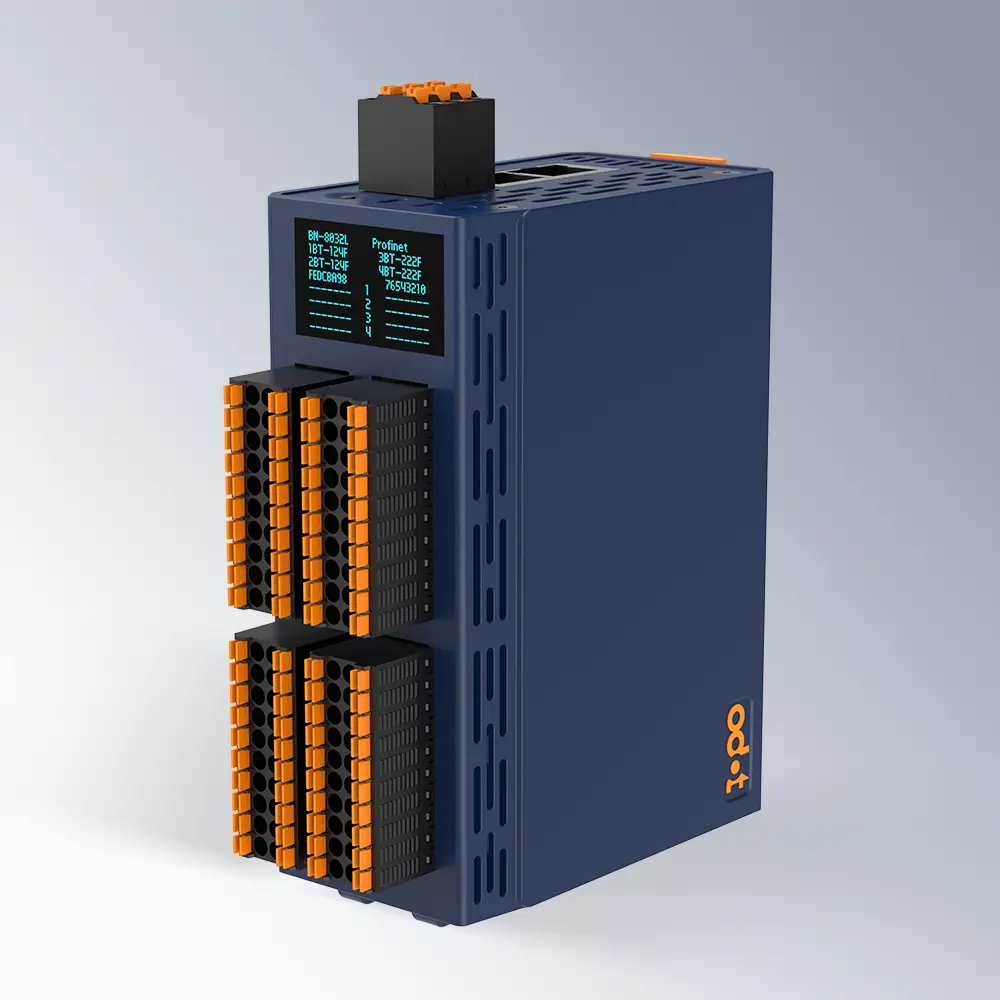
Distributed I/O is used in manufacturing areas where equipment and signals are spread across machines or production zones. A conveyor system may require local connections for photoelectric sensors, limit switches, motor status, and valve commands. A packaging machine may use multiple stations to collect signals from feeding, filling, sealing, and discharge sections.
Placing I/O near these devices can reduce the need for long point-to-point cable runs. It can also support modular machine design, allowing separate sections to be installed and tested before being connected to the main control system.
The control strategy remains dependent on the PLC program and network configuration. Remote stations provide signal interfaces; they do not automatically determine how the machine should respond to those signals.
Integration with Existing Controllers
Compatibility is the most important technical issue when adding remote I/O to an established system. The controller must support the selected network and device type, and the engineering software must be able to configure the hardware correctly.
For EtherNet/IP installations, engineers should review adapter compatibility, electronic data sheet requirements, connection limits, network addressing, and controller firmware. Legacy systems may require specific communication modules and wiring arrangements.
A migration project should also consider how existing I/O addresses and program references will be affected. Replacing a station may require changes to the controller program, HMI tags, alarms, and maintenance documentation.
Planning Signal Capacity
The I/O schedule should list each field signal and identify whether it is digital, analog, temperature-related, or specialized. Module selection should account for channel count, voltage or current range, isolation, output loading, and environmental conditions.
Where the plant expects future changes, spare capacity may be useful. However, adding more modules than necessary can increase cabinet space, network data, and project cost. A balanced design should reflect realistic expansion plans.
Safety functions must be treated separately. Standard distributed I/O should not be assumed to provide safety-rated performance. Protective functions require compatible safety hardware and an appropriate validated design.
Troubleshooting and Lifecycle Support
A remote I/O fault may arise from a failed power supply, damaged network cable, incorrect configuration, incompatible firmware, or a problem with a field module. A systematic diagnostic process should examine controller messages, adapter status, network indicators, and local channel conditions.
For older installations, lifecycle support is especially important. Spare-part availability, software access, replacement options, and the risk of unplanned obsolescence should be reviewed. A staged migration plan may be preferable to waiting until a critical component becomes unavailable.
Maintain accurate backups of controller programs, hardware configurations, network settings, and device documentation. These records can be essential when restoring a system after a component failure.
Conclusion
Allen-Bradley remote I/O applications range from established legacy installations to modern distributed control architectures. Successful integration depends on identifying the exact hardware generation, confirming controller and protocol compatibility, and planning the effects of changes on software and maintenance. A careful assessment helps facilities preserve reliable operation while preparing their automation systems for future upgrades.