

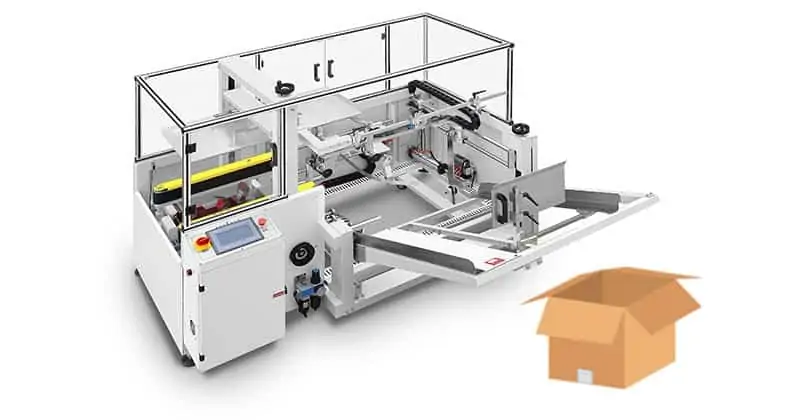
Carton compatibility is an important consideration when introducing automated case forming into a packaging operation. Even a well-designed machine can experience inconsistent results if the cartons vary significantly in size, material, construction, or quality. Matching the packaging material to the equipment helps maintain reliable production and reduce avoidable interruptions.
An Automatic Case Erector is built to open, square, and form flat cartons into usable cases with limited manual intervention. Its performance, however, depends heavily on whether the cartons meet the machine’s operating specifications. Understanding these requirements can help manufacturers select suitable packaging materials and maintain smoother production.
What Makes a Carton Compatible?
Carton compatibility refers to how well a case’s physical characteristics match the capabilities and configuration of the forming equipment. Several dimensions and material properties need to work together for reliable case erection.
Important considerations include:
- Carton length, width, and height
- Corrugated board thickness and grade
- Flute type and board strength
- Crease and fold quality
- Adhesive or joint construction
- Carton weight and rigidity
When these characteristics remain consistent, the machine can handle cases more predictably.
Carton Dimensions Matter
Case erectors are generally designed to operate within specified dimensional ranges. If a carton falls outside those limits, the forming mechanism may not be able to grip, open, or square it correctly.
Dimensional consistency is equally important. Two cartons with the same nominal measurements can behave differently if manufacturing tolerances are too wide. Consistent carton production therefore plays a major role in maintaining automated packaging performance.
Board Strength and Material Quality
Corrugated board must have enough strength to withstand the forming process without collapsing or becoming distorted. At the same time, excessively rigid material may require greater forming force or behave differently during folding.
Moisture can also influence board performance. Changes in humidity may affect stiffness and dimensions, which can lead to inconsistent opening or squaring. Storing cartons in suitable conditions can help preserve their intended characteristics.
Creasing and Folding Accuracy
Properly formed creases help guide the carton through the opening process. If score lines are too shallow, too deep, or poorly positioned, the case may not fold along the intended points.
Damaged or crushed carton edges can create similar problems. Before cartons enter an automated line, their structural quality should be checked to ensure they can withstand mechanical handling.
Joint and Adhesive Considerations
The manufacturer’s method of joining the carton can also affect compatibility. Glue joints, stitched areas, and other construction methods may influence how the blank opens and maintains its shape.
Poorly bonded joints can cause cases to separate during forming, while excess adhesive may interfere with folding or handling. Consistent carton construction is therefore important for dependable automated processing.
Matching Cartons to Machine Settings
Even compatible cartons may require appropriate machine adjustments. Guides, sensors, forming mechanisms, and other components may need to be configured according to the case dimensions and material characteristics.
When switching between carton sizes, operators should use the recommended setup procedures rather than relying on approximate adjustments. Correct configuration reduces the likelihood of misalignment, jams, and incomplete case formation.
Common Compatibility Problems
Several issues can indicate that cartons and equipment are not properly matched. These may include:
Cases Failing to Open
A carton may remain partially closed because of excessive board stiffness, poor scoring, damaged material, or incorrect machine settings.
Uneven Case Squaring
If a case forms at an angle or does not maintain a square shape, the cause may be inconsistent dimensions, weak board, inaccurate creases, or incorrect guide positioning.
Frequent Jams
Repeated jams can result from carton deformation, unsuitable dimensions, damaged edges, or operating conditions that exceed the material’s practical limits.
Inconsistent Feeding
Feeding problems may occur when cartons have different thicknesses, warped surfaces, or variations in dimensions. Maintaining consistent carton quality can make automated feeding considerably more reliable.
Testing Cartons Before Full Production
Testing packaging materials before introducing them into full-scale production can reveal compatibility issues early. A representative sample of cartons should be processed under normal operating conditions.
Testing should consider different production batches when possible, since material characteristics can vary between suppliers or manufacturing runs.
The Role of the Carton Supplier
Communication between the packaging equipment operator and carton supplier can prevent many compatibility problems. Suppliers should understand the dimensional and material requirements of the forming equipment.
When changing carton specifications, businesses should also consider whether the new material remains suitable for automated handling. A change made for cost, appearance, or product protection can sometimes affect machine performance.
Maintaining Consistent Performance
Carton compatibility is not a one-time consideration. Packaging materials, suppliers, production volumes, and machine settings may change over time.
Regularly reviewing case quality, monitoring forming problems, and recording recurring faults can help identify compatibility issues before they cause significant downtime. This approach is especially useful for operations handling multiple carton formats.
Techflow Pack
Ultimately, reliable automatic case forming depends on a good match between the equipment and the cartons it processes. Consistent dimensions, suitable board characteristics, accurate creasing, strong construction, proper storage, and correct machine setup all contribute to dependable performance. By evaluating these factors before and during production, manufacturers can improve case-forming consistency and create a more stable packaging workflow.


