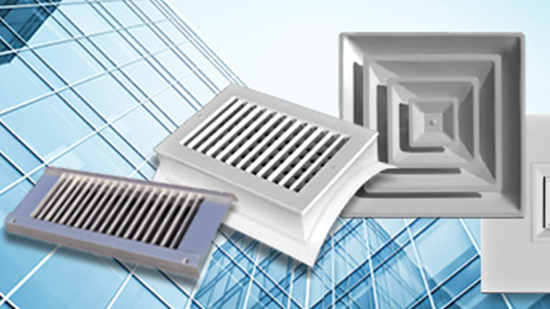
HVAC systems rely on properly designed air distribution components to maintain indoor comfort, air quality, and energy efficiency. Among the most important elements are grilles and diffusers, which control how air is introduced into or removed from a space. Although often grouped together, they serve different purposes and come in a wide range of designs and materials.
Understanding hvac grilles and diffusers is essential for engineers, contractors, and building designers who want to create efficient ventilation systems for residential, commercial, and industrial environments.
Understanding HVAC Grilles and Diffusers
Grilles and diffusers are both air terminal devices used in HVAC systems, but they perform different functions.
- Grilles are primarily used for air return or exhaust and provide basic airflow passage with minimal air direction control.
- Diffusers are designed to distribute conditioned air evenly into a space while controlling airflow direction, velocity, and spread.
Together, they ensure balanced air circulation and proper system performance.
Types of HVAC Grilles
Grilles come in various designs depending on their application and airflow requirements. Each type serves a specific role in ventilation systems.
Fixed Blade Grilles
Fixed blade grilles have stationary louvers and are commonly used for return air applications. They provide simple airflow passage and protection for duct openings.
Adjustable Blade Grilles
These grilles allow users to manually adjust airflow direction, offering better control in certain ventilation setups.
Return Air Grilles
Designed specifically for air return systems, these grilles help channel air back into the HVAC system for reconditioning.
Door Transfer Grilles
Installed in doors or partitions, these allow air movement between rooms, helping maintain pressure balance.
Types of HVAC Diffusers
Diffusers are more complex in design compared to grilles and are used to ensure uniform air distribution throughout a space.
Ceiling Diffusers
Common in offices and commercial buildings, ceiling diffusers distribute air evenly from overhead locations.
Linear Slot Diffusers
These modern designs provide a sleek appearance and allow flexible airflow direction, often used in architectural spaces.
Swirl Diffusers
Swirl diffusers create a circular airflow pattern that enhances air mixing and improves temperature consistency in large areas.
Jet Diffusers
Designed for long-distance air delivery, jet diffusers are used in large open spaces such as airports and industrial halls.
Floor Diffusers
Installed in raised floor systems, these diffusers are often used in data centers and modern office environments.
Materials Used in HVAC Grilles and Diffusers
Material selection plays a crucial role in durability, performance, and appearance.
Aluminum
- Lightweight and corrosion-resistant
- Widely used in commercial HVAC systems
- Offers a clean, modern appearance
Steel
- High strength and durability
- Suitable for industrial or heavy-duty environments
- Often used where structural strength is important
Plastic (ABS or PVC)
- Cost-effective option
- Resistant to moisture in certain environments
- Common in residential applications
Finishing Options
To enhance durability and aesthetics, manufacturers often apply:
- Powder coating for corrosion resistance
- Anodized finishes for aluminum products
- Custom colors for architectural matching
Design Considerations for HVAC Grilles and Diffusers
Design plays a major role in both performance and visual integration within a building.
Airflow Efficiency
Proper design ensures balanced airflow, reducing hot or cold spots and improving comfort.
Noise Control
Well-designed diffusers help minimize noise caused by air movement, especially in offices and residential spaces.
Aesthetic Integration
Modern HVAC components are often designed to blend seamlessly with ceilings, walls, or floors.
Installation Flexibility
Different mounting options allow easier integration into various HVAC system layouts.
Applications in Different Environments
HVAC grilles and diffusers are used across a wide range of settings, each with specific requirements.
Residential Buildings
- Diffusers provide comfortable airflow in living spaces
- Grilles support ventilation in bathrooms and kitchens
Commercial Buildings
- Diffusers ensure uniform air distribution in offices and retail spaces
- Grilles manage return air and system balance
Industrial Facilities
- Heavy-duty grilles handle airflow intake and exhaust
- High-capacity diffusers support large ventilation loads
Healthcare and Hospitality
- Precise airflow control supports hygiene and comfort requirements
- Quiet operation is essential for patient and guest environments
Importance of Proper Selection
Choosing the right combination of grilles and diffusers is essential for HVAC system efficiency. Incorrect selection can lead to poor airflow distribution, higher energy consumption, and reduced comfort.
Proper selection helps achieve:
- Balanced air circulation
- Improved energy efficiency
- Better indoor comfort
- Reduced system strain
Conclusion
HVAC grilles and diffusers are essential components that work together to ensure efficient air distribution, system balance, and indoor comfort. With a wide range of types, materials, and design options available, selecting the right combination is critical for achieving optimal HVAC performance.
By understanding hvac grilles and diffusers, engineers and designers can create systems that deliver reliable airflow, energy efficiency, and long-term performance across residential, commercial, and industrial applications.